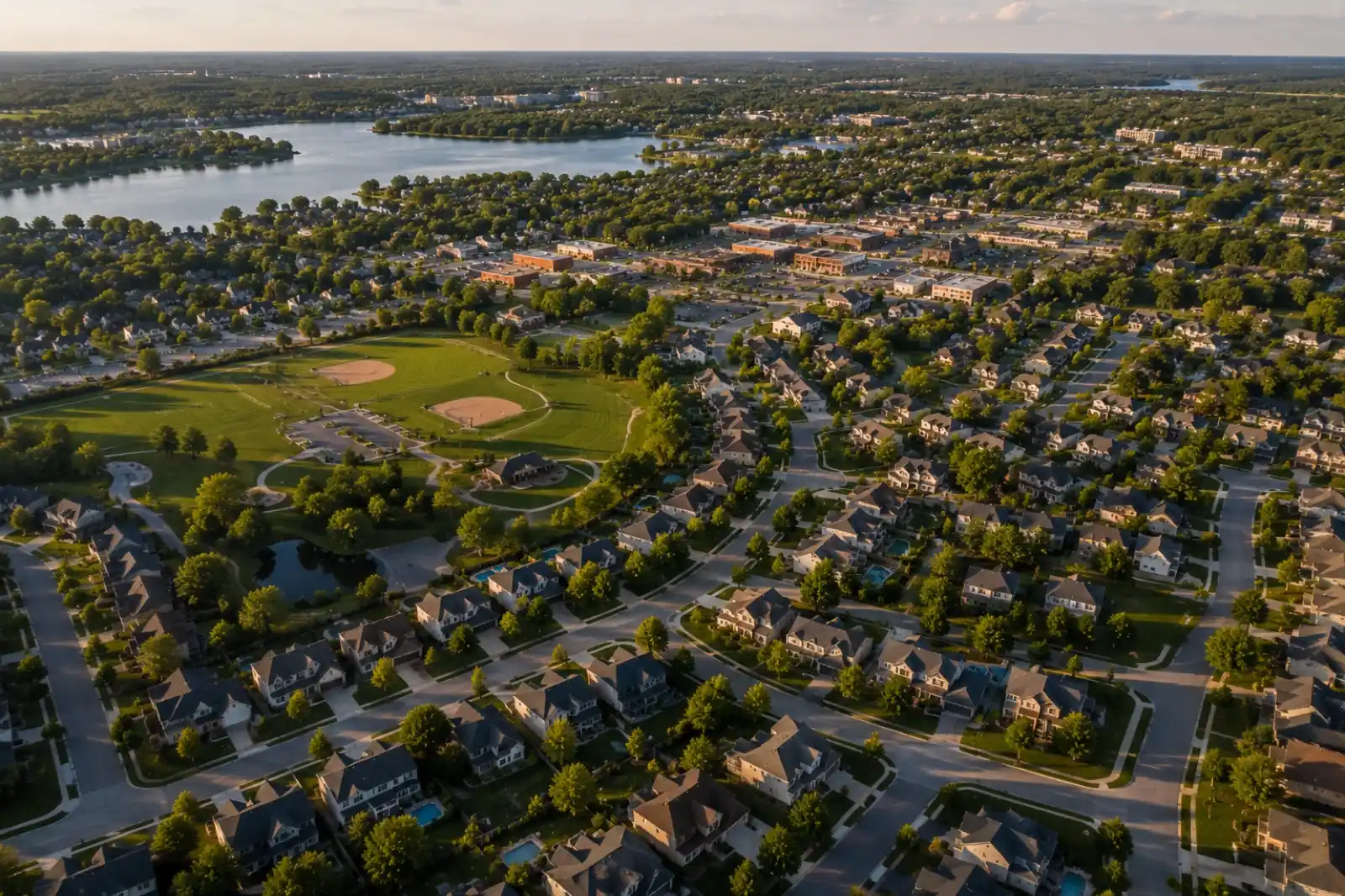
Dallas–Fort Worth is one of the fastest-growing metro areas in the country, and most of that growth lands in the suburbs. There are dozens of them, they market themselves similarly, and the differences that matter are not the ones in the brochures. Here is a framework rather than a ranking — because the right answer depends on where you work and what you need.
The northern corridor
Plano is the established one: mature neighborhoods, a substantial corporate employment base, and housing stock that spans several decades. Frisco is newer, has grown extraordinarily fast, and is heavy on recent construction and amenities. McKinney keeps a historic downtown square and tends to offer more space for the money the further north you go. Allen sits between them and draws families for similar reasons.
Further out — Prosper, Celina, Little Elm — you find newer developments, lower prices, and longer commutes. That trade is the central one in north DFW.
The mid-cities and the west side
Between the two downtowns sit Irving, Grapevine, Euless and Bedford — often overlooked, frequently well-located, and a genuinely good answer if your household commutes in two different directions. Southlake and Colleyville are the prestige addresses on this side. Arlington sits squarely in the middle of the metro and offers a different value equation entirely.
West of Fort Worth — Aledo, Weatherford — you get more land and a more rural feel, with the commute to match.
Compare on these, not on reputation
- The specific attendance zone. District reputations are blunt instruments. Boundaries split neighborhoods, and fast-growing districts redraw them. Verify the exact address and ask whether a rezoning is under discussion.
- Both commutes. If two adults work in different parts of the metro, the mid-cities often beat either end. Drive it at the real hour.
- Housing age. A 1980s Plano house and a 2020 Celina house are different maintenance propositions. Neither is better; they are different budgets.
- Tax rate at the address. Overlapping entities vary by city and district. Two similar homes in adjacent suburbs can differ meaningfully. See our Texas property taxes guide.
- HOA and MUD. Common in newer developments. Get the documents and the current rates during your option period.
- Storm exposure. North Texas sees significant hail. Ask about roof age and claim history, and get an insurance quote before you are committed.
A note on new construction
Much of DFW's family housing is newly built, and buying from a builder is a different transaction from buying a resale. The builder's representative works for the builder. You can and should bring your own agent — see our guide to new construction in Texas for what to negotiate and when to bring representation in.
Looking for an agent who actually works this area? Get matched free — we connect you with one license-verified local agent (plus at most one backup), never a call center and never a list sold to five people. Matching is always free for buyers and sellers.
The tax-rate difference between adjacent suburbs is real money
Because your bill is the sum of independently set rates from every overlapping entity, two similar houses in neighbouring DFW suburbs can carry meaningfully different annual costs. Over a thirty-year hold that difference is substantial, and it does not show up anywhere in a listing price comparison.
Before you narrow to a city, ask for the combined rate at a representative address in each of your candidate suburbs, and add any MUD or PID that applies. It occasionally reorders a shortlist entirely. Our Texas property taxes guide explains what stacks into the number.
Growth has consequences worth pricing in
The suburbs absorbing the most growth are also the ones where infrastructure is still catching up. That shows up as school boundary changes, road construction on your commute for several years, and — in the newest communities — amenities that exist on the site plan before they exist on the ground.
None of that is a reason to avoid a fast-growing suburb. It is a reason to ask specific questions: is a rezoning under discussion for this attendance zone, what road projects are funded on my route, and which of the amenities in this brochure are contractually committed?
Two-commute households should look at the middle
The most common DFW planning error is optimising for one person's commute. If your household drives in two directions, the mid-cities between the two downtowns — Irving, Grapevine, Euless, Bedford, Colleyville — frequently produce a better combined outcome than either the far north or the far west, even when neither person is thrilled about the address on paper.
Do the arithmetic on both drives, at the real hours, before you rule the middle out.
How to compare schools honestly
District reputation is the blunt instrument buyers reach for, and it obscures more than it reveals in a metro this large. Compare the specific campuses your address feeds — elementary, middle and high — because a household buys into three schools, not one. Ask whether attendance boundaries have been redrawn recently or are under review, since in fast-growing districts they move. And visit if you can: the things that determine whether a school fits your child are not in a rating.
Frequently asked questions
Which DFW suburb has the best schools?
Several districts are consistently well regarded, but the honest answer is that it varies by campus and by attendance zone. Compare the specific schools your address feeds, not the district's overall reputation.
Is it cheaper on the Fort Worth side?
Generally, yes — Fort Worth and its western suburbs tend to offer more house per dollar than the north Dallas corridor. Weigh that against where you actually commute.
How far out should I go for more space?
Only as far as your worst realistic commute day tolerates. People routinely overestimate their tolerance in the first year and regret it in the second.
Can Homegrity match me to an agent in one specific suburb?
Yes — that is the point. We match on the areas an agent actually covers and their verified record there, not on who paid the most. Placement is never for sale.
Agents: if you work this market, join the network. Your profile is free, you keep 100% of your commission, and placement is never for sale — you're ranked on your verified record in the areas you actually cover, not on an ad budget.